
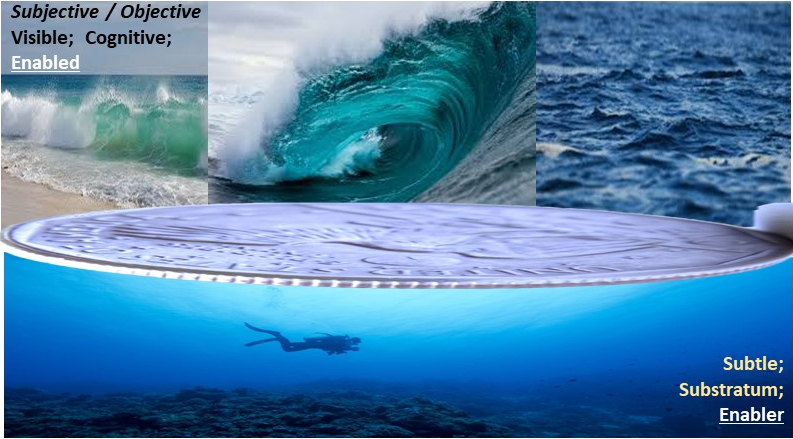
Spiritual perspective:
Ability to remain calm and peaceful (like the deep ocean),
while things within and around us are turbulent
(like the waves on the surface of the ocean)!
In a recent conversation with a young man, close friend and a brilliant intellectual, I was introduced to the phrase “Spiritual bypassing”. He was referring to the people claiming to be spiritual, but who in their own life, are protected and isolated from the harsh realities of daily life. Hence they are not confronted with the daily issues of ordinary people. Instead, they give superficial advice and guidance to people and their inevitable problems. This phrase – Spiritual bypassing – struck a chord in my thoughts recently. I have been dealing with several issues of life, some of my own and a few from those who have reached out to me. One example: Another friend felt the financial pressures of daily life, even to meet some important commitments to protect the family or take a small family vacation without adding up to credit card debt. This person was asking “Despite my best efforts, am I destined to live a life of meager income and limited means?” I had to gently challenge my friend to confront the reality of life. Some may have fortunes showered on them, while some others may have to struggle as his/her life happens to be now. No one will know for sure what will happen tomorrow. Doing one’s best effort and also being content with what we have at a given time are the only real outlets. That is pursuing one’s duty. Merely promising a bright future and suggesting special courses in meditation or religious services as the way out, would be “Spiritual Bypassing”?
Following is a selection on Spiritual bypassing:
In the 1980s John Welwood, clinical psychologist, psychotherapist, teacher, and author coined the term spiritual bypassing. In his 2002 book Toward a Psychology of Awakening, he defined spiritual bypassing as using “spiritual ideas and practices to sidestep personal, emotional ‘unfinished business,’ to shore up a shaky sense of self, or to belittle basic needs, feelings, and developmental tasks.”
Rose Hahn in her article Spiritual Bypassing: What It Is & How To Avoid It, writes: Bypassing occurs when spiritual ideals get elevated to the realm of absolute truth in such a way that our real, lived experience is somehow denied. Rather than doing the work of healing deep wounds, we may use these ideals to deny, devalue, or avoid meeting our more human needs – such as emotional bonding, love, and esteem. In other words, rather than risk opening ourselves to real human connection, and possibly get hurt, we adopt a more “enlightened”, spiritual way of relating to the world that doesn’t rely on human relationship.
Psychosocial rehabilitation specialist Kendra Cherry in a very wellmind article described how “Spiritual bypassing is a way of hiding behind spirituality or spiritual practices.”
In our book on Spirituality in Practice we point out that everything we experience is governed by three connectors: Knowledge, Bias and Ignorance. It would appear that “Spiritual bypassing” may be the outcome when our Bias or Ignorance overwhelms our knowledge of Spirituality and how to apply that in practice.
Spirituality is the ability, desire and will to seek and identify with the common driving force (Spirit) across everything. From such a point of view or alignment, you can see the common framework for everything and why they are like that within you and around you. This spiritual perspective gives you the ability to remain calm and peaceful (like the deep ocean), while things within and around us are turbulent (like the waves on the surface of the ocean)! This point of view is illustrated in the figure above.
Consider for example remaining silent. It is considered a hallmark of a spiritually evolved person, liberated, free from the perturbations of our daily life. But, “Silence” at all times by itself may not reflect true evolution in spiritual qualities of a person. Please see: “Many facets of Silence” – Page 281:
Am I silent because I don’t know anything better to say or do? Am I ignorant of the fact that I am supposed to say something and empowered to speak? Am I inertial and unwilling to use the skills of thinking, reasoning, speaking, and influencing bestowed on me? Am I silent because I am overcome by my ignorance reflected as my Inertia?
Am I silent because I am fearful of speaking? Or am I angry and unwilling to speak? Am I proud and feel that the listeners are not worthy of my words? Overwhelmed by emotions I am not mindful of the opportunity lost? Am I overcome by my turbulent mind and its bias, desires and attachments? Am I silent to avoid superficial and momentary bad feelings?
Spirituality is not a detour or bypass to circumvent the issues and challenges of daily life. To manage our every moment as reflected through our knowledge, bias and ignorance at that moment is Spirituality. It is like driving a bicycle or a car. Every driver of a car or a rider on a bicycle has to confront the issues at every moment, like the potholes and detours along the way. It would be “Spiritual bypassing” to suggest that one should ignore the potholes in our life experiences or the detours that we have to face in life?
Excessive focus on Yoga, meditation, visit to the temples or church services, prayer and other routines for daily rituals without intense reflection on their meaning and purpose, could end up in spiritual bypassing. What is needed may be a steady and rigorous reflection on all these activities and how they can help one towards the overall goal of being at peace within and also remain connected with everyone and all that surrounds us. Please see: May the guest Transform into God! – Page 289.
Each of us are constantly challenged with the deluge of daily issues and challenges. It may be due oto relationships, issues in care giving, work place issues, having to make close call on work, family, financial matters, etc. To suggest that one “should not be disturbed or upset about their financial plight and merely feel better by looking at the brighter side” would be spiritual bypassing. Instead rigorous financial analysis of income vs. expenses, find ways to do better at the job to gain more income as best as possible, add some activities in life that also generate funds to supplement their current income, etc. are all possible logical alternatives. Ideas on working with the rest of the family members to be sure that they are healthy and satisfied in spite of the lower standard of living due to low income, small local activities for time off reflecting the true meaning of vacation, that is not a huge financial burden, etc. will surface when the self-reflection is deep, objective and more based on reasoning and less driven by emotions. With all these things in place – managing the potholes – one can compare his/her life with many others. The brighter side of life would become self-evident. To reinforce this positive thinking, and further cultivate a calm mind, yoga or meditation could be useful?
As human beings we are all governed by our mind and our ebb and flow of thoughts. No one can think for me except myself! The same is true for you and everyone. Spirituality is a way of conditioning our mind to live through the ebb and flow of thoughts, while maintaining a balance or equilibrium along the way. It is a self-driven process managed by oneself. All spiritual advice or guidance or steering the mind from external sources reach their limit, while self-reflection is always required to play its role leading to self-realization. This is the Mind over Matter, Pages 103 to 115. Following passage further explains the false notion of Spiritual bypassing:
Can one give up the householder’s life, even though it is no longer appealing, when one has a wife and children? What then will be their fate? It is selfishness, pure and simple. To be in the world and maintain a family, to fulfill one’s duties — certainly this too is religion. Nothing is gained by suddenly giving up everything. One cannot climb to the roof at one bound. One must ascend step by step. Sri Ramakrishna used to say: “A fruit picked before maturity rots and becomes spoiled. A sore bleeds if you take away the scab too soon, but it drops off by itself when the sore is healed.” What fine illustrations these are! Everything depends on the mind alone. If one happened to be married but later regretted it and informed Sri Ramakrishna of his intention to embrace the monastic life, the Master would say: “Wait. Don’t give up the world. If you are sincere, everything will fall into place. You only have to faithfully pursue the course laid down in the scriptures.”
Source: Ramakrishna As We Saw Him, Edited by Swami Chetanananda; Ch 12 Swami Turiyananda, p 227,
How do we know if one is a true practitioner of “Spirituality in Practice” vs. those engaged merely in spiritual bypassing? Those to whom spirituality is part of their inner core, they are always aware of their ego: Thoughts and emotions centered on the self. Where the “self” is identified as something different from others is “ego”. This ego diminishes when there is a genuine feeling that the self and others are one and the same, part and parcel of the universal consciousness! SiP leads one ready to be in the company of others as easily as they feel at home alone! Everyone’s problems are their problems. Everyone’s joy is their own joy. They truly reflect the spirit of Sarve’ Jhana Sukino Bhavanthu (May everyone and indeed everything remain at peace and in harmony). Following passage from the life of Saint Ramakrishna illustrates this meaning of spirituality in practice:
… the Master always appreciated the talent of the gifted and paid respect to those worthy of it. He said: “Look, God is displeased if one doesn’t pay respect to an honorable person. They have become great by His power. It is He who has made them great, so by neglecting them, one neglects God.” We therefore understand why whenever the Master heard of any noble person in a particular place, he was immediately eager to meet that person by any means. He was delighted if that great one came to him; otherwise, he would visit that person uninvited to pay his respects and to converse with him or her. Thus, he visited Padmalochan, the court pandit of the Raja of Burdwan; Pandit Ishwar Chandra Vidyasagar; Mahesh, the renowned vina player of Varanasi; Gangamata, the well-known female ascetic of Vrindavan; Keshab Chandra Sen, the famous Brahmo leader, and many more. The Master heard of their noble qualities, and then on his own initiative sought such people out and arrived at their doors.
It is not surprising that the Master appeared at someone’s door uninvited, because this thought never occurred to him: “I am a great man. If I were to visit someone in this manner, I would cheapen myself and lose my prestige.” He had completely burnt his ego and vanity to ashes and consigned them forever to the Ganges …
Source: Sri Ramakrishna and His Divine Play, by Swami Saradananda, translated from Bengali by Swami Chetanananda; Volume 4 Sri Ramakrishna as a Guru – Part 2, p 659
 Spirituality In Practice
Leave a comment