
I receive a weekly “Spiritual message” composed and edited by a good friend and published through The Vedanta Society, local chapter at Saint Louis, MO. They are brief and amazingly good. Each communication carries a brief message that is ideal for reflection and internalizing. I look at them as sources of learning. Any comments as noted below are merely for enhancing my perspective and not a criticism in its negative sense.
The recent message was titled: Why do God’s children suffer so much?
Who can understand the divine play of God? Man experiences happiness and misery according to his own karma. This is true of every man — whether he is learned or ignorant, good or wicked. Rare indeed is a person in this world who enjoys uninterrupted peace and bliss! Blessed is he who is free from desires, for he lives in the kingdom of peace. There is more misery than happiness in this world, and most people live in misery. If God is all-merciful, then why do his children suffer so much? Only God knows the answer to this mystery, and not ordinary human beings.
Man suffers because of his ignorance, which manifests as “I” and “mine.” The really happy and fortunate man is he who has given up his ego and has surrendered his life, mind, and intellect to God, and has nothing to call his own.
The nature of the mind is to dwell on worldly objects, because it is created out of the three gunas (sattva, rajas, and tamas) which also constitute the outer world. It is only through divine grace that a man can withdraw his mind completely from the external objects and put it on God.
God Lived with Them, by Swami Chetanananda
Ch 2 Swami Brahmananda, p 88
Above is a perfectly acceptable and a very good message for anyone coping with suffering and misery in life. It addresses several questions from different perspectives:
Theology (Based on faith in God, a Super-being):
Who understands my misery and suffering and how?
It is all the divine play of the Lord.
How does this divine play work leading to my experiences of pain and suffering?
Based on the law of Karma (Any bad deed on my part in the past,
shows up as my pain and suffering now).
How can I live without misery?
A life free from desires. It is the kingdom of peace.
Am I alone suffering this misery?
There is more misery than happiness in this world, and most
people live in misery.
How can I become free of my misery?
The really happy and fortunate man has surrendered his life, mind,
and intellect to God, and has nothing to call his own.
How can one truly live a life with nothing to call his own (withdraw his mind completely from the external objects)?
It is only through divine grace that a man can withdraw his mind
completely from the external objects and put it on God.
Above is a complete and consistent set of guidelines, based only on faith and surrender unto the Lord. This is the way of life for most people, especially in rural in India. As an example, my grand mother lived all her life with this common refrain “Eshwaro Rakshatu” (God will take care of it.)
My grandmother was not literate. She would not have read the above passage. But it would be beneficial for us, if we reflect and do not skip the Philosophical gems buried inside the above message!
Philosophy (Based on Analytical Reasoning):
- Man suffers because of his ignorance, which manifests as “I” and “mine.”
- The really happy and fortunate man is he who has given up his ego (the notion of “I” and “mine.”)
- The nature of the mind is to dwell on worldly objects, because it is created out of the three gunas (sattva, rajas, and tamas) which also constitute the outer world.
Let us consider each of the above pearls of Philosophic wisdom:
- Man suffers because of his ignorance, which manifests as “I” and “mine.”
It is a “self-evident” truth that I, as a man, a human being, is as much part of nature, as are the stones, plants, animals and all other people on this planet earth. https://www.youtube.com/watch?v=J8gFRsStfE0
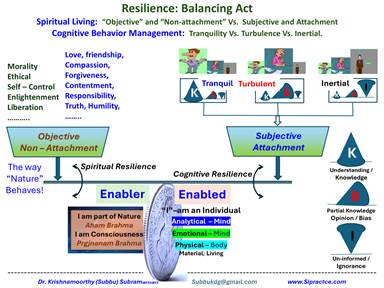
To think, “I” am different from the rest – from all else that exists identified as “nature” – is my ignorance. The Vedic Maha Vakya (Grand Pronouncement) reminds us of this self-evident truth: Tat Thwam Asi (You and the Universe are one and the same). Whenever we see ourselves as the same and indistinguishable part of nature, our misery and sufferings dissipate. First the intensity of such pain and suffering diminishes. The loss of someone in our family does not cause as much grief or pain when we see that person as someone in the community at large. Loss of something in our property (like a broken tree in your backyard) is easier to tolerate when you see it as a tree in the neighborhood! All are parts of nature! In due course such an outlook fosters a perspective of Objectivity and Non-attachment, a way of life. This is the way of life where the notion of “I” and “mine” are held in check.
- The really happy and fortunate man is he who has given up his ego (the notion of “I” and “mine.”)
“Ego” is often a misunderstood term. It is not “ego” to want anything, to enjoy good food or feel the pain and suffering of any loss. They are normal human tendencies, endowed by nature. But, in our observations, thought, reflection and analysis, whenever we fail to see that we are nothing more than nature as it exists and cling on to the notion that “I am different”, that foolish attachment is “ego”!
Events happen as part of nature. To characterize them as “good” and “bad” comes from our attachments. We see two mangoes on the store shelf. They make no difference to us. But as soon as I want to buy a mango (own it, get attached to it), one mango appears better than the other! I am driven to buy the “best mango” on the shelf!
We can not live a life without the “notion of “I” and “mine” ”. Yet it is precisely what I need to give up to live a life peace, contentment and happiness!
Is there a way to overcome this Conundrum?
One pathway is Theological:
With unwavering conditioning of our mind towards faith in the Lord. God is the knower of everything, who blesses me with my good fortune as well as my misery and suffering based on my Karma!
Another pathway is Philosophical:
This is the way is to manage our mind and the way we relate to the world around us through reflection and analysis. The next pearl of Philosophical wisdom as noted below, helps to better understand this pathway!
- The nature of the mind is to dwell on worldly objects, because it is created out of the three gunas (sattva, rajas, and tamas) which also constitute the outer world.
As humans we are the product of our mind and its connection (as well as response) to the world around us. The connectors (rope or guna) are Tranquility (sattva), Turbulence (rajas) and Inertial (tamas). The building blocks of these connectors are Knowledge, Bias and Ignorance. They co-exist all the time. When Knowledge is dominant over Bias and Ignorance, we are Tranquil. When Bias is dominant over Knowledge and Ignorance, we are Turbulent. We feel agitated. We experience misery, pain and sorrow. When we are turbulent, sometimes we also experience unbridled happiness, which in the end leads to more “I” and “mine”. This devolves into more pain and suffering. When Ignorance is dominant and aided by Bias, with no Knowledge in sight, we suffer from grief! https://sipractce.com/2025/05/11/resilience/
Summary:
God’s children suffer when they drift away from their faith in the benign hands of a Superbeing, the Lord.
As God’s children, they also suffer when they do not use God’s blessings – the human mind – to constantly reflect and manage the prevailing Knowledge, Bias and Ignorance and their interplay. Self-reflection becomes limited when we fail to see that “I”, “You”, “everyone” and “everything” is part of one seamless universe, the “nature” (Tat Thwam Asi) as stated in the Upanishads.
Finding ways to combine the “Theological” as well as the “Philosophical” pathways and benefit from both would be Spirituality in Practice?
 Spirituality In Practice
Leave a comment