
Mental Health and Wholistic Wellness
Dr. Krishnamoorthy (Subbu) Subramanian
A recent panel session on Mind Matters, hosted by Wholistic Health alliance, was an interesting and informative event. https://wholistichealthalliance.org/ The poster for this event can be seen below, which highlights the speakers at this event. We have noted a few thoughts gathered from this session. In the end we offer a schematic illustration to organize our understanding of “mental health” and the various pathways towards such knowledge and education, much needed for anyone seeking wholistic wellness in mental health!
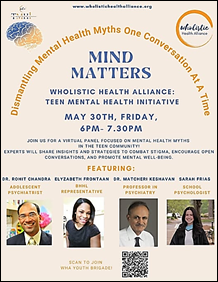
Few highlights from the panel discussion:
- How do you describe “mental health”?
- It is a difficult question with many answers, depending on the context and point of view.
- Why is it difficult to talk openly about mental health?
- Because of the “stigma” associated with it.
The stigma may come from:
- “Self-Stigma” due to fears and apprehensions coming from within oneself.
- “Public Stigma”, where the fear and apprehension may come from the general public and their bias and ignorance in describing and understanding what “mental illness” is and what it is not.
- “Structural Stigma” due to Institutionalized views and perspectives.
Dr. Kesavan pointed out that “mental health concerns are often equated to Schizophrenia. There are cases where use of a different name to identify the illness could have resulted in different course and better outcome”.
- Inability to describe “mental health” precisely also leads to difficulty in communicating about issues surrounding mental health! Stigma of any kind is broken through awareness, which also helps us to realize that we are never alone. Others are in the same boat as well.
- Parents need help as they care for their children, often students with mental health concerns. Every parent is a “Care giver”. They need education and training pertaining to:
- Planning the necessary steps and action for mental health care.
- Separation of their personal and daily life (which must go on) from the needs of the patient and their care.
- Available pathways and resources for treatment.
- Acceptance of the reality that despite grief and hardships, one must strive as best as one can, with confidence and hope for a better tomorrow.
- It was a sobering revelation to learn that greater than 50% of cases of mental illness are noted before the teenage years of the patients.
- The key requirements for better mental health care are:
- Awareness
- Access to health care options and resources
- AffordabilityAppropriate Care
- Advocacy
- Comments on Wholistic Mental Health:
With the above summary in mind, we can ask the question what is “Mental Health”?
This question pre-supposes that we have the answer to the question “What is mind”?
Paradoxically, often we struggle to find answers to the question of “What is mental health?”, without first clarifying what is the “Mind”, the health of which we are interested or concerned about!
What is the “mind”?
We can think of our mind in three realms:
- Brain (as a Physical Organ):
Brain: The physical organ responsible for thought, action, and awareness. It’s a complex network of neurons and other cells that process information. Different brain regions are associated with specific functions, such as memory, language, and emotions.
Our brain is a crucial physical organ that acts as the body’s control center, coordinating all bodily functions, including movement, thought, and sensation. It’s a complex structure composed of neural tissue, not muscle, and is protected by the cranium, cerebrospinal fluid, and meninges. The brain is responsible for everything from basic functions like breathing and heart rate to higher-level processes like learning, reasoning, and emotions.
The brain acts as the body’s central control center, receiving information from the sensory organs and coordinating responses. The brain functions as an agent for:
Motor Control: The brain controls voluntary and involuntary movements through a network of nerve pathways.
Sensory Perception: The brain processes sensory information from the five senses, allowing us to experience the world.
Cognition: The brain enables higher-level cognitive functions like learning, memory, and language.
Emotion and Behavior: The brain plays a crucial role in regulating emotions and behaviors.
Overall, the brain is a highly complex and essential organ that is responsible for all aspects of our physical and mental well-being.
Source: Google AI Summary
Enormous progress is being made in the understanding and treatment of the brain as a physical organ in everyone of the above functions. The brain is truly a miracle of nature, along with our heart, lungs, kidneys and so many other parts. The brain is literally the conductor of the orchestra we call human beings!
- Mind as a “driver”, with Brain as the “driven”:
Mind: The mental processes that result from the brain’s activity. Includes thoughts, feelings, memories, perceptions, and experiences. The mind can be viewed as the content of consciousness. Research suggests the mind is not a separate entity but rather a product of the brain.
Source: Google AI Summary
We can think of our brain as a critical part of a well-oiled machine – called human body. If our body with the brain in it is like a car or bicycle, then our “mind” is like the driver of the car, or rider on the bicycle!
You can pull apart and put back together parts of the brain – which is what Brain Surgeons do – just like we pull apart the car or bicycle for repair and maintenance! Our Cognition, emotion and behavior is governed by our mind and executed through our brain and in turn through our body, as we engage in the world of activities.

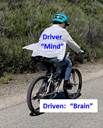
There are many descriptions known for the mind-body connectivity or interactions.
The brain is a physical organ responsible for coordinating bodily functions and thought processes, while the mind refers to the subjective experience of consciousness, including thoughts, feelings, and emotions. In essence, the brain is the hardware, and the mind is the software.
Source: Google AI Summary
A framework to understand the connection between our mind (as the driver) and our brain (as the bicycle or the driver) can be derived from Vedic Philosophy. We call this as the “Connector Science”.
The word used for “Connector” is Guna, which literally means rope in Sanskrit language or something that connects things together! Details on the role of the connectors (Guna) and how they facilitate, foster or influence our Cognitive behavior can be learned from these two short videos:
Learning and then using our Knowledge, Bias and Ignorance as tools to manage our Cognitive Behavior is a vital aspect of addressing our “emotional Health”, a key component of mental health and wellness.
- Consciousness the “enabler”:
The term “Consciousness” is a difficult term invoking multitude of explanations. It is not our goal here to define or engage in any intellectual discussion or debate.
The terms “brain,” “mind,” and “consciousness” are often used interchangeably but have distinct meanings. The brain is the physical organ, while the mind is the mental process and experiences that arise from the brain’s activity. Consciousness refers to our awareness of ourselves and our surroundings, including our thoughts, feelings, and perceptions.
Consciousness: Our awareness of ourselves and our environment. It’s the subjective experience of being aware of something. Consciousness is a complex phenomenon that scientists are still trying to understand. Some scientists believe consciousness arises from the brain’s activity, while others propose it’s a non-physical phenomenon.
Consciousness is not an all-or-nothing phenomenon; it can vary in depth and type of relationships. The mind is the content of consciousness. Neuroscience is exploring the neural basis of consciousness, seeking to understand how brain activity relates to our subjective experiences. Understanding the relationship between brain, mind, and consciousness is a key area of research in neuroscience, psychology, and philosophy.
AI responses may include mistakes.
Source: Google AI Summary
Consciousness as the “enabler”, with our Mind and Brain as the “Enabled”:
As a lay person, one can say “I am Conscious” because I am aware that I am alive. I can breathe, thanks to my heart beating, lungs breathing, blood circulation, brain functioning, etc. All these are aspects of nature. I understand all of these and many more to the extent I can. As evidence of my being alive I can see objects, and hear voices, and digest food, etc. In other words, one could say “I am conscious” reflects the existence and functioning of a collection of phenomena or capabilities of nature. We understand some of these phenomena and to the extent we understand them we try and manipulate them or manage them. There are many others we do not know or know well enough. Yet, they exist and enable us to exist and function as human beings! It is the way all nature exists and behaves.
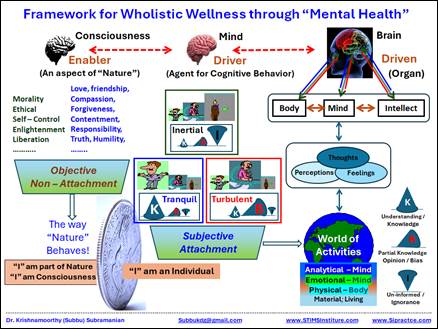
We have carved out a segment of the “nature” as it applies to us – the humans – and given it a name “Consciousness”. We can describe consciousness to the extent we can describe nature. We struggle to define or describe consciousness to the same extent we struggle to define and describe “Nature” in its totality. This understanding of “Consciousness” as part of nature, the enabler behind the “mind” the driver and the “brain” our physical organ is illustrated in the figure below. This schematic is suggested only as a framework to conceive of wholistic wellness through “mental health”.
SUMMARY:
The above schematic or framework is offered merely as an illustration, for anyone to gain a handle on the mental health issue or concerns in a broad framework.
The brain as a biological organ is a complex devise in and of itself. Well-functioning Brain directly impacts on our physical body, emotional wellbeing as well as our ability to think and reason (analytical skills). Through these we engage in the world of activities as illustrated in the figure above. This is our world of perceptions, feelings and thoughts. Cardiovascular exercises are the means to strengthen and improve the fitness of our heart and lungs. Yoga, meditation and relaxation techniques and proper sleep habits are considered good for the brain and its health.
While every organ of the human body is vital, the brain makes all the rest work well. Physical health of the brain affects almost every other part of the human body. Lack of adequate blood circulation to the brain, quality of the blood flowing to the brain, rest and recuperation needed for the brain are among the many factors that affect the proper functioning of the brain. That in turn affects other parts of the body – very rapidly or over the course of time. Many aspects of malfunctioning brain and its direct impact on human health are well known such as “stroke”, etc.
Brain functions through the neural network. Hence many aspects of neural functions are connected with physical disfunction in the brain. Psychiatric symptoms (Anxiety, agitation, hallucinations, and delusions) may be considered as emotional weakness of the individuals, while their source may be an ailment of the brain as a physical organ. Abdominal pain (often severe and intermittent), Neurological symptoms (Muscle weakness, numbness, tingling, paralysis, and seizures) and Skin symptoms (Blisters, swelling, scarring, and disfiguration) are reported as being caused by poor health of the brain! Information and help for all these aspects of the brain as a physical organ, its care and wellbeing must be sought from medical experts and specialists in this field.
Source: Google AI Summary
Beyond the physical organ, the brain is also the playfield of the mind. A general framework is available (from Vedic Philosophy) on the nature of connection between our mind (as the driver) and the brain (as the driver). We are not presenting scientific details here on the connection or the process. Instead, it is hypothesized that our action, behavior of any kind, is governed by the signals received through the brain and our response to the signals, reflected in our actions and experience. This signal processing occurs through three channels, connectors or rope. The Sanskrit term for rope is Guna. The three connectors are Knowledge, Bias and Ignorance (as illustrated in the figure). Also see the links cited above. These three connectors (sources of signals for inputs as well as response) are co-existent all the time. Yet, the dominance of one over the other two reflects our experience or behavior. The resulting Tranquility, Turbulence and Inertia are illustrated in the figure above! This is our world of activities, thanks to our subjective nature and attachment through our identity as individuals (“I”, “me”, “mine” and different from others, different from nature). It reflects the ebb and flow of life, like the waves on the surface of the ocean. The ocean waves never die. All we can do is manage these waves with a constant awareness of our Tranquility, Turbulence and Inertial state of affairs governed by our prevailing Knowledge, Bias and Ignorance. It is our Cognitive Behavior Management (CBM). Education, understanding and use of CBM may be the most important need for teenagers and their parents, with a good and well-functioning brain. It is also an important aspect of managing our mind and our emotional health.
Our understanding of brain-mind relationships continues to evolve. The neuroplasticity research of recent decades shows the brain is more adaptable than previously thought. This actually supports emphasis needed on practices like meditation and yoga for brain health. Emphasis needed on Cognitive Behavior Management (CBM) as essential for teenagers and parents is well-founded and practically relevant. Psychiatric symptoms potentially originating from physical brain dysfunction is clinically important. Medical experts observe that structural brain changes can manifest as mood, behavioral, or cognitive symptoms that might otherwise be attributed to psychological (brain/mind interactions) causes alone.
Finally, we come to the question, “Why do I feel let down, even when things are going well?” Most often, people who are well off, with fortunate tiding in many aspects (education, finance, parents, family, good health, etc.) feel let down. Questions of “Why me?” bother them and the question of “Why not me?” never surfaces in their brain / mind! The question can be restated as “Why do I feel like a doormat?”. This is due to a failure to see the reality – nature – as it is. If we think that “doormat” is just another object of nature, equally worthy of respect, doing its designated function without regret, then the notion of doormat as an inferior object never enters our mind! Can we think, even for a moment, that “I am indistinguishable and inseparable part of nature”. It is also the truth! In those moments we become Objective and Unattached. It is like being part of the deep ocean that enables all the waves on its surface. It is the way nature exists. It is the other side of the coin as illustrated in the figure. The perspective of nature as a whole (the enabler) and the individual or cognitive sphere of “I” as an individual are like two sides of a coin, co-existing and inseparable. While the cognitive side of “I” is identified as the individual, the other side of the coin, where no distinctions of any kind exist may be recognized as “Consciousness”. https://www.youtube.com/playlist?list=PLwk3-BGQQsfVg8wkZdUarazGgs0RlYhO3
This perspective of our mind – being in union with nature – is described as “Spirituality”. It is not religious or denominational. It allows us to smell the rose and enjoy the beauty and elegance of all that we have. Spirituality allows us to accept the rose with its thorn, appreciate the contents in the glass even if it is half full. Words like “Love, Friendship, Compassion, Forgiveness, Contentment, Responsibility, Truth, Humility, ..” that appear abstract begin to acquire meaning as their impact spread across individuals to family and across communities. Qualities such as “Morality, Ethics, Self – Control, Enlightenment, Liberation, …” become more concrete and less abstract for a spiritual mind.
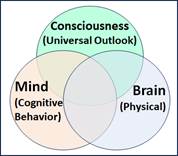
Wholistic wellness of for mental healt through
Brain, Mind and Consciousness as interactive components.
The question What is “Mental Health”? may be answered as:
- Physical Health of the Brain as an organ and its related functions of the human body as a whole.
- Emotional Health – interplay of our body and mind, leading to Cognitive Behavior and its Management
- Spiritual Health – wholistic view of our body and mind as an integral and inseparable part of nature as a whole. It is a universal outlook. The stability and equanimity that comes from spiritual health in turn reinforces and enhances the emotional and physical health of our mind/brain/body complex!
It is true that Brain is a complex organ and mind / consciousness are complex to understand. All are subjects of deep study by experts and scholars. But that does not have to make “mental health” obscure and confusing.
- One can take care of their brain and its health, just as we do for all other parts of the body through proper training and fitness regimen. This includes Yoga and meditation, rest and sleep.
- We need widespread education on reflecting and characterizing our prevailing Knowledge, Bias and Ignorance at any time and all the time. This self-awareness is the foundation for Cognitive Behavior Management. This CBM is a unique need for human beings!
- We also need a cultural shift in the society as a whole to see ourselves as a product of nature and its forces (collectively recognized as Consciousness or the “spirit”). We are all indivisible part of nature – like droplets of water in a body of water. Plants and animals live that way, enabled and nurtured by the forces of nature. We exist and thrive in the same manner as well. Yet, endowed by our well-developed brain and mind – also gifts of nature – we learn to exist as individuals, divided and different from each other. We humans have the capacity to live as individuals as well as an undivided part of nature.
Wholistic awareness and care for “mental Health” requires sustained effort in each of these three pathways independently, collectively as well as in an interactive manner!
 Spirituality In Practice
Leave a comment