
This essay has been published at veDa vaaNee e-magazine and posted at: https://vedasamskrutisamiti.org.in/wp-content/uploads/2025/10/R3.-Axioms-of-Vedic-Philosophy-%E2%80%93-Tools-for-Being-and-Becoming-a-Good-Samaritan_41-46.pdf
Parable of Good Samaritan:
The Good Samaritan is a parable told by Jesus Christ in the Gospel of Luke (Luke 10:25-37). It tells the story of a traveler who is beaten, robbed, and left for dead on the road from Jerusalem to Jericho. A priest and a Levite, both figures of religious importance, pass by without offering help. A Samaritan, a person from a group traditionally despised by Jews, stops and cares for the injured man, even taking him to an inn and paying for his care. The parable is a lesson on loving one’s neighbor, particularly those in need. The parable challenges the idea of who is considered a neighbor (1) . The reference cited – a blog-post – also calls our attention to remind each of us to become Good Samaritans, especially now, where being a neighbor and friendly in nature to help each other is being challenged on many fronts including economic security and concerns, fake news, self-isolation fostered by social media, etc.
The same powerful thought and its simple, yet universal message for humanity is also noted in the Vedic Philosophy (i.e.) learn to see anyone and everyone and for that matter anything as yourself, as an undivided part of nature – Tat Twam Asi. This thought enables anyone to become and behave like a Good Samaritan, instinctively! While I am just another ordinary human, to the extent I think and try to live true to the above principle, the joy of uplifting others – anyone – seems to come alive naturally like the fish floating and swimming effortlessly in a body of water or the leaf fluttering in its space as the wind passes by.
When I drew attention to this to another friend, he acknowledged the valuable message of the parable and its resonance with the Vedic grand pronouncement (Maha Vakya) mentioned above! He added: “from childhood, norms and customs train us to be most efficient to take care of our own needs, may be exclusively to the point of avoiding others and their needs, like the priest and the Levite in the above parable. These limitations have been there for eternity. May be the priest and the Levite who stood aside, were even tired of their good deeds they have done in the past?” Such personal limits in our behavior come to the surface as long as we think of ourselves and others as different from each other. To think and live in that thought that “I” and everything else are all part of the same substratum is the first axiom of Vedic Philosophy (2).
Three Axioms of Vedic Philosophy:
Axiom 1:
Everyone and everything are an integral part of nature, the same “Universe” (Tat Twam Asi). The entirety of nature and its description by the human mind, the mind itself and its capabilities are all enabled by countless phenomena, and all their effects are represented through a single common noun “Brahman”. Such Brahman is indescribable, without features or characteristics, except that assigned by the human mind. Brahman is “Nirgunathvam” – without association or connection with anything. It remains in and on its own accord.
Axiom 2:
Enabled by our mind, as human beings, we are required to live a life of our own identity – different from others. This self-identity (Gunathvam) and the belief that “I” exist independent of others and independent of nature and its forces is also described as “ego”! Ego is stated as Ahamkaram in Sanskrit language. It implies: “I” am the agent responsible for this outcome; this is “I”, these are “mine”. You, I or anyone exist, thanks to the connections (Guna) created by our mind with nature, through our Knowledge, Bias and Ignorance. Hence, we exist and live a life of Tranquility, Turbulence and Inertia (known as the three Guna). The Sanskrit term Guna literally means rope (that which connects and ties things together)! These three connectors co-exist all the time and create a spectrum depending on the time, place, context, circumstances, etc. It is this pattern – the spectrum or wave like constant variations – that we call as individual life and its experiences. One can understand his/her own connections (Guna) as precisely as one can – at an instant, in an event or as part of a course of events – through Objectivity (equal regard for all evidence of K, B and I) and looking at the evidence by stepping away from them (non-attachment). This outlook is described as Sagunathvam. This leads to equal treatment or equal response to all happenings around us. It is like being a judge and judgmental. The ideal person is in the state of Sagunathvam. Hence God, defined as the “ideal” person – Purusha Uttama – is described as being in Sagunathvam.
Axiom 3:
Both – our lives as integral part of nature and our lives as individuals different from others – are symbiotic, each linked to the other, intimately without any separation like the waves on the surface and the deep ocean on which the waves reside! Nirgunathvam (Nature, Brahman, Consciousness) and Gunathvam (Being a human with all our life experiences) are like two sides of a coin, always co-existing. It is also like the rider and his bicycle, driver and his car, Charioteer and his Chariot.
The seed and the tree that grew from it are inseparable. Illumination and what we see as a result are inseparable.
Axiom 1 reflects the “enabler” and Axiom 2 reflects all that is “enabled”. They are inseparable, the entirety of both sides (mentioned above as Axiom 3) is also identified as “Brahman”
Beyond the two-sided coin analogy, there are several other models used to describe the universe:
- Purusha (Axiom – 1) and Prakruthi (Axiom -2);
- “Creator” and “Creation”,
- “Dehinam” and “Deham”,
- “Charioteer” and the “Chariot”, etc.
Universal Outlook:
Axiom 1, as expounded through the Vedic Maha Vakya (Grand Pronouncement) “Tat Twam Asi” leads to a universal outlook. It is one of undivided union with all, without exception. It is also Self-evident. We are made up of materials just like all other objects of material universe. We are born and grow and perish just as the corn plant grows from its seeds, yields more corn and perishes at the end of the season (3).
Kathopanishad 1.1.6.
अनुपश्य यथा पूर्वे प्रतिपश्य तथाऽपरे ।
सस्यमिव मर्त्यः पच्यते सस्यमिवाजायते पुनः ॥ ६॥
anupaśya yathā pūrve pratipaśya tathā’pare .
sasyamiva martyaḥ pacyate sasyamivājāyate punaḥ .. 6.
Nachiketa said:
Look back and see how it was with those who came before us and observe how it is with those who are now with us. A mortal ripens like corn and like corn he springs up again.
One does not feel like a “doormat” and the indignities associated with it, if our mind truly believes that everything including a doormat are objects of nature, worthy of regard and respect. It is precisely for this philosophic universal outlook that children are trained to abstain from kicking any object with disregard! When such thought extends further our mind thinks and believes that all objects and living beings are worthy of care and protection.
Episodes from Indian literature are replete with examples of characters who display the universal outlook often in terms of profound and instinctive generosity, or “dāna“, a fundamental virtue in Hinduism.This goes beyond mere charity; it emphasizes giving without expecting anything in return and often involves a spontaneous, selfless act driven by compassion and a deep understanding of our interconnectedness. Thus, universal outlook from Sanatana Dharma is noted in the well-known story from ancient Tamil literature of Pari Vallal, a Tamil chieftain renowned for his exceptional generosity. It is said that he gifted his chariot to a jasmine creeper (4) . The story recounts how King Pari, while traveling, noticed a jasmine vine on the roadside, struggling to grow without support. Moved by compassion, he dismounted from his chariot and offered his chariot as support for the plant. This act of kindness reflects a mind that sees the self – “I” – as an integral part of everything around us. Tat Twam Asi.
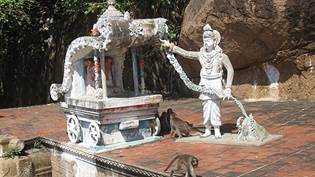
A statue of King Paari giving away his chariot as a support to a climbing wine
Image source: Wikipedia.
Here are a few more examples:
When a dove, pursued by a hawk (Indra in disguise), seeks refuge in King Shibi’s lap, he vows to protect it. The hawk demands the dove as its rightful prey, but Shibi, driven by compassion, offers a portion of his own flesh equal to the dove’s weight. He consistently cuts flesh from his body, but the scale never balances. Finally, in an act of profound self-sacrifice, the king places himself on the scales, demonstrating his willingness to give his entire being to save another life. This narrative (5) reflects a deep sense of responsibility towards all living beings, even a bird at its time of need!
King Rantideva during a time of famine in his kingdom shared in the suffering of his subjects by fasting for 48 days. (6) As he was about to break his fast, he encountered a thirsty man and gave him his glass of water. Shortly after, a hungry guest arrived, and Rantideva offered his morsel of food. When another thirsty man appeared, Rantideva, despite his own extreme hunger and thirst, offered his remaining water without hesitation. He expressed his desire to take on the suffering of all beings to free them from misery. This empathetic response to the suffering of others is driven by a desire for universal well-being.
These stories illustrate that the universal outlook in Sanatana Dharma goes beyond material offerings. It’s about a fundamental shift in perspective where the well-being of others is prioritized above personal comfort, security, or even life itself. Such acts are driven by compassion, selflessness, and a deep understanding of the interconnectedness of all beings, leading to spiritual growth and the attainment of higher states of consciousness. Higher the level of “Objectivity” and “non-attachment” in our act of generosity, closer the individual reaches the divine nature. In such acts and behavior of compassion and unity with nature – Tat Twam Asi – one transforms into a Good Samaritan unknowingly and without declaration! Being and becoming a Good Samaritan is an outcome and not a goal for those who pursue the Axioms of Vedic Philosophy as a way of life (i.e.) practitioner of Sanatana Dharma.
This concept of “Universal Outlook” may be seen in the teachings of Ramana Maharishi. It is reported that while meeting this saint, the devotees would express their personal anguish to him. It is said that he would simply ask them to reflect on a simple question: “Who am “I”?”. When the notion of “I” as an individual dissolves into the notion that “I” am an inseparable and integral part of everything else (Tat Twam Asi), our problems transform into events enabled by forces of nature. In that instant our “problems” disappear.
Any one in an open space under pouring rain and thunder, feels helpless! As soon as the person thinks of himself as another living being, as part of nature, fears and apprehensions go away. Emotions are replaced by valiant efforts to seek shelter for oneself as well as for anyone around us. This spirit of being a “Good Samaritan” is revered in some families on the banks of river Cauvery. They celebrate a festival “Kaappulavadu Samaaradhana” in the beginning of any happy family occasion such as wedding, etc. It is a feast offered to the entire village as a show of respect for “Kaappulavadu”. The story, several decades old, is recanted even today: Many families were being swept away in the floods due to the swelling flow of the Cauvery river. An unknown person – good Samaritan – is said to have shown up with his boat and carried the families to safety. The term “Kaappulavadu” in Telugu language literally means one who protects and hence “Kaappulavadu Samaaradhana” translates into a feast in honor of the one – unknown – who protects us!
In a recent Webinar on Suddha Sadhakamu (7) Sri Haragopal refers to liberation (Moksha) as the state of mind that sees oneself as integral with the universe. The Telugu phrase mentioned in this talk “Neynu Neyne” reflects the thought, while I exist as part of nature, integral and inseparable, whatever is conceived by myself as “I” is created by the notion of who I believe I am! Hence being a good Samaritan is a genuine and instinctive reflection of Self-control, where our mind sees the needs and well being of anyone as the needs for oneself!
As individuals, being a Good Samaritan is also inevitable if one truly appreciates Axiom 2 of Vedic Philosophy, as stated above. It reflects on how we manage our mind to reflect ourselves in the situation of others. Consider a serious roadside car accident The moment our mind sees a role reversal and “I” am the person involved in the accident, jumping into action to help – being a Good Samaritan – is almost instinctive. Developing such thought – of role reversal – as a natural part of our living is suggested by Objectivity and non-attachment, hallmarks of divinity in our daily life. Some may find asking for help a bit too naive and shameful. While we are all integral and inseparable part of nature, we remain divided as individuals thanks to our knowledge, bias and ignorance (Vedic Philosophy – Axiom 2). (Please see above). Feeling naive to either ask for help when genuinely needed or hesitant in volunteering to help when a need truly arises, are both “biases” built into our thinking and in the society! This self-isolation may be at the core of many mental health disorders today, especially in our youth and in their parenting.
Our knowledge, bias and ignorance are also the impediments that pose constraints on being a good Samaritan. Vedic Scriptures relentlessly address the issues of Bias and Ignorance and the need to minimize them. That effort, by its very nature enhances our knowledge and engagement into action as good Samaritans.
Conclusion:
Spirituality in Practice – being and becoming a true Good Samaritan instinctively – is as much a practical philosophy as it is the need in our society worldwide. It requires deep and sustained reflection on the Axioms of Vedic Philosophy, not as academic information, but in their in-depth understanding and practice in our daily life!
Hari Om.
References:
- Being a Good Samaritan in unneighborly Times: https://francisclooney.hsites.harvard.edu/news/2025/07/good-samaritan-unneighborly-times
- Vedic Philosophy summarized in three points – https://sipractce.com/2025/07/06/vedic-philosophy-summarized-in-three-points/
- Kathopanishad 1.1.6 https://vivekavani.com/kau1c1v6/ Accessed on August 18, 2025
- Pari Vallal Vēl Pāri – Wikipedia
- https://www.storyandreligion.div.ed.ac.uk/wp-content/uploads/2015/08/King-Shibi-and-the-Dove.pdf Accessed on August 18, 2025
- http://www.balagokulam.org/kids/stories/rantideva.php Accessed on August 18, 2025
- VSS Webinar on Suddha Sadhakamu by Sri Haragopal 03 May 2025 https://www.youtube.com/watch?v=KuvMHcl7XCg
 Spirituality In Practice
Leave a comment