
Book Review:
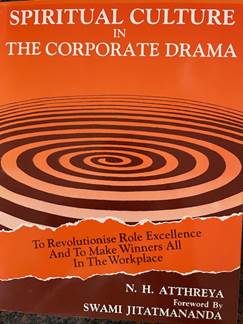
Following is a brief review of the book titled “Spiritual Culture in the Corporate Drama”, authored by late Prof. N.H. Atthreya. It is a book written “to revolutionize role excellence and to make winners all in the workplace”. This book was published in 1997 by Vijay Foundation, Mysore, India.
The author Prof. Atthreya is a long-term student of human excellence in general and corporate excellence, in particular. Prof. Athreya holds a Ph.D. in Business Administration and advanced degrees in Mathematics, Management Accounting and Organizational Psychology. He is a founding member of the Indian Management Association. Prof. Atthreya passed away in 2024 as he reached 100 years in life.
This book is comprehensive and well written. In the following review, we have compiled a few short passages from this book, as a summary!
This review has been published in veDa vaaNee e-magazine and posted at: https://vedasamskrutisamiti.org.in/wp-content/uploads/2025/10/SSN2.-Spiritual-Culture-in-the-Corporate-Drama-Book-Review_92-94.pdf
Spiritual Culture in the Corporate Drama – Book Review.
Spiritual Culture includes care and concern for “Others”. It reveals that we are all – “Sparks” of the same divinity.
We all play a role in life assigned to us. When we play this role well, we create joy for others as well as joy for ourselves. This role play on the stage, which we call life, also applies to corporate work life!
Role playing involves role excellence. The player in the stage play takes the role excellence as responsibility and enjoys such responsibility as long as the role lasts.
For corporate success we need role excellence. For role excellence we need role respect. Such respect for one’s role comes from within. It is not merely a matter of organizational structure or values laid out by others.
Role excellence requires persistent effort. Until the role holder chooses to strive, to persist, role excellence becomes merely a matter of chance. “This voice for role excellence is a matter of stage culture” states Prof. Atthreya. “In any play, to ensure role excellence, the player accepts the role, holds himself responsible, prepares for the role, plays the role well, each time better than the time before! He respects other’s roles, understands them and relates with them appropriately and intelligently. He makes sacrifices, does not take himself for granted, nor does he take others and their roles for granted. He knows he is playing in a drama; he knows his role is part of a scene, one or few passing moments in the duration of the play, yet he knows that he must be fully engaged and be at his best for that duration of his role in the play!”
“He knows he is far different from his role, yet he performs by being one with the role, for the duration of the play. He is committed that while the show lasts, it must be a good show!”
“There are four key stakeholders in any stage play: The audience, other players in the show, the producer or organizers as well as the player involved. The same applies to any corporate function or responsibility. Here we have the customers, fellow workers or employees, corporate owners or management as well as the professional or the employee. Everyone has to play their part – their roles – for the show to go on!”
Every player and every role in a stage play is equally important. It is equally true for a spiritually minded person. All are to be regarded as equals. “To respect every role, we need to understand and appreciate each role and its place in the overall scheme of the play. We also need to have a deeper understanding of the role which has an impact on our own role and in turn how our role impacts on others. For the roles of others close or intimately connected to us, we can constantly ask ‘how can I make it easy for you to play and excel in your role?’”
“Awareness at a higher level makes a difference in the consistency of role excellence. Education helps awareness. Company-wide education and re-education continually and consciously helps every person to subscribe to the need and place of role excellence. We need to help everyone become aware of the fact that being true to a spiritual reality is a human privilege and one should treasure it.”
“By spiritual culture, we mean understanding, conceding and obliging spiritual reality. It is another dimension of all of us, a vital dimension, an integral dimension. It is a dimension that, when recognized, brings out the best in us, the very best in us, the divinity in us, so to speak. We tend to bless all, we tend to make winners all. Spiritual reality is not denial of other realities. Instead, it is an enveloping reality that is pervasive and supports all other realities such as the material, physical, emotional and intellectual realities that we bring into use in our role excellence.”
“One aspect of spiritual reality is the spark of divinity, the cosmic essence that provides infinite potential power within each of us. With God within us and with us, we can accomplish much for the benefit of all of creation. We can purposefully create, positively maintain and deservedly destroy, as an agent of the whole, an instrument of the divine.”
“Spiritual culture also reflects our interconnectedness. At one level we are all virtually connected. Brotherhood of all men is only the beginning; unity of all existence is the essence.”
“Whatever we think, say or do goes recorded in a sort of supercomputer, which works on the basis of cause and effect. No interference of any kind can extricate us from logical consequences. Today we make our tomorrows, in the larger and longer sense, knowingly and unknowingly.”
“Mankind wants happiness, peace, joy and bliss. They want freedom at its best: Ananda. They realize it often in unguarded moments.”
“When we oblige the above aspects of reality, we tend to observe some of the key components of the pursuit of human excellence (viz.) caring, sharing, loving, serving and sacrificing.” Over time, they become the foundations of role excellence, display of Spiritual Culture in The Corporate Drama!
Reviewer:
Dr. Krishnamoorthy (Subbu) Subramanian
Honorary Editor, veDa vaaNee.
 Spirituality In Practice
Leave a comment