
pdf file for more pictures Humpi
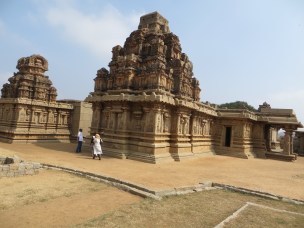
During my recent travel to India I had the opportunity to visit Humpi, a historic place in the northern part of Karnataka state. It was truly a marvelous experience, a journey into the past. Humpi was the capital city during the rule of Krishnadeva Raya. His Vijayanagar Empire was large and his dynasty ruled from 1343 to 1565. http://www.karnataka.com/hampi/about-hampi/ The temples, castles and the stone carvings are exquisite in their detail and marvelous in their engineering and architectural features. http://hampi.in/history-of-vijayanagara
The tour guide told us that the entire city was abandoned as the ruling dynasty lost out in war with the invading Moghuls, who plundered the city and left it in ruins. There were not any rulers here during the entire British rule of India, we were told, since there were no residents here to pay any taxes. The Humpi ruins reportedly have been restored after the democracy in India and funding by the Indian Government in the early 1950s. Now it is a recognized UNESCO world heritage site.
The history of this region dates back to the Ramayana times. The Pampa Sarovar nearby is a picturesque lake on the mountain side. According to mythology Lord Rama met Saint Sabari here. There is also a Vali Cave nearby where the monkey king Vali was supposed to have been hiding for fear of persecution by king Sugreeva.
The Virupaksha Temple in Humpi dedicated to Lord Shiva is still a functioning temple with worship services. The fort, castles and many other historical buildings in different states of ruin have been restored and offer a glimpse of the days of a successful empire. The visit reminds one of the travels in Rome, Ephesus in Turkey or Pompei. But, these are all ruins from the Roman times, at least 1000 years ago. It was hard for me to imagine that the entire living area was vacated only 450 years ago. Also it was never occupied till a few decades ago in a country of large and dense population! These thoughts boggled my mind, until I came across another historic ruin, the village of Kuldhara in the northern state of Rajasthan, near Jaisalmer. I did not visit Kuldhara, but saw a documentary on it during my flight back home, a timely coincidence.
Kuldhara was the name of the largest village in this community consisting of 84 villages. The village was established in 1291 by the Paliwal Brahmins and was a rather prosperous community due to their ability to grow bumper crops in the rather arid desert. But one night in 1825 all the people in Kuldhara and nearby 83 villages vanished in dark. Why did the villagers decide to leave their settlement after having lived there for more than seven centuries?
http://undiscoveredindiantreasures.blogspot.com/2012/04/kuldhara-story-is-one-of-weirdest-and.html
http://www.geni.com/projects/Kuldhara-Abandoned-Village-in-Rajasthan-India/6144
For reference, 1825 was only 190 years ago! There are several stories that describe the possible flight of the residents from this village of Kuldhara. One is the story of a local Diwan – local Lord and tax collector during the British rule – wanting to marry a Brahmin girl, aged 12. He promised to return when the girl would come of age suitable for marriage. The family decided to desert the land instead of this marriage out of caste. Another is the story of the invaders who after plundering the wealth polluted the wells used for drinking water. This forced the residents to flee. Third is the story of the ghosts that abound this village. The fourth and possibly more scientific is the drying out of the meager local water supply forcing the locals to flee and never return here again.
Whatever the reason, the ruins of India tell us a lot more about the life not many centuries ago, but also about the recent past. Somehow this thought – that the ruins can be connected with recent history – took me a while to digest and internalize. Time has meaning only in the context in which we assign meaning to it, I suppose.


 Spirituality In Practice
Leave a reply to askaranth Cancel reply