
Recently a paper titled “Focused attention, open monitoring and loving kindness meditation: effects on attention, conflict monitoring, and creativity – A review” from the frontiers in Psychology was brought to my attention by one of my friends who is a medical professional. https://www.ncbi.nlm.nih.gov/pmc/articles/PMC4171985/#!po=7.95455
For reasons of full disclosure I must admit that I have no training in psychology, nor do I profess any special expertise in meditation. But on reading this paper I could not but admire the parallels between the principles and steps outlined in this paper and the methods one can observe in Hindu traditions and rituals.
The paper outlines three steps for meditation:
- Focused attention meditation (FAM)
During FAM the practitioner is required to focus attention on a chosen object or event, such as breathing or a candle flame. To maintain this focus, the practitioner has to constantly monitor the concentration on the chosen event to avoid mind from wandering.
Once practitioners become familiar with the FAM technique and can easily sustain their focused attention on an object for a considerable amount of time, they often progress to OMM.
- Open monitoring meditation (OMM)
During OMM the focus of the meditation becomes the monitoring of awareness itself. In contrast to FAM, there is no object or event in the internal or external environment that the meditator has to focus on. The aim is rather to stay in the monitoring state, remaining attentive to any experience that might arise, without selecting, judging, or focusing on any particular object.
To start, however, the meditator will focus on a chosen object, as in FAM, but will subsequently gradually reduce this focus, while emphasizing the activity of monitoring of awareness.
- Loving-kindness meditation (LKM)
LKM incorporates elements of both FAM and OMM. Meditators focus on developing love and compassion first for themselves and then gradually extend this love to ever more “unlikeable” others (e.g., from self to a friend, to someone one they do not know, to all living beings even the one they disliked).
Any negative associations that might arise are supposed to be replaced by positive ones such as pro-social or empathic concern.
It is also noted in this paper that “several approaches (like Buddhism) favor a particular sequence of acquiring meditation skills (from FAM to OMM)”.
Based on the above it would appear that what is generally known today as Yoga – which is truly Hatha Yoga – is largely practiced centered on FAM. The attention is focused on specific muscle or muscle-group and its manipulation while keeping in harmony with the breathing process.
Let us look at two of the Hindu traditional practices / rituals that reflect progression from FAM to OMM to LKM.
Puja or worship service:
https://sipractce.wordpress.com/2015/07/18/athithi-dhevo-bhava-may-the-guest-transform-into-god/
Every Hindu worship service starts with focus on a specific God. The place is cleaned, seat offered, water purified which is used to cleanse the idol, decoration with flowers and chosen objects (of high value to the worshipers) followed by offering of food (Prasad) – all focused on the idol of the deity being worshiped. This would appear to be remarkably parallel to FAM. Instead of the focus on a single short term event like breathing or manipulation of the muscle, focus here is on a single longer term event – worship services with several well defined steps.
The above is followed by lighting of the lamp and its offering (Deepa Aradhana) together with the prayer song noted in Kato Upanishad (2.2.15) and also in Bhagawath Geetha (15.6)
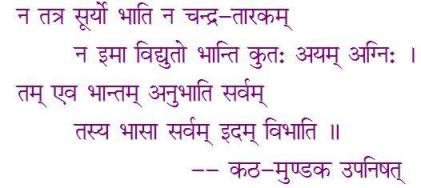
which translates to:
Transcend to that space where even the sun does not shine by itself, nor the moon or the stars, nor lightning, or even fire. All of these bright objects shine by reflecting that One. This whole Universe is illumined by That light (the Atman).”
Through the above praer the focus in the worship service has moved past specific objects and activities to an abstract union with the soul (Athman) seen as the enabler of anything tangible and visible. OMM can be noted here thanks to the focus on consciousness (inner self), something abstract even while using a tangible object such as the glow of the fire created by the flame in the lamp as the indicator.
At this point the devotee – the worshiper – silently prays for the blessings of the god. In an ideal prayer the devotee moves gradually past seeking any personal favors to seeking favors for a broader cross section of the society and in the end into a seamless state of good will that knows no bounds. This largely mirrors the LKM mentioned above.
Final rites at Gaya (Gaya Shrardham):
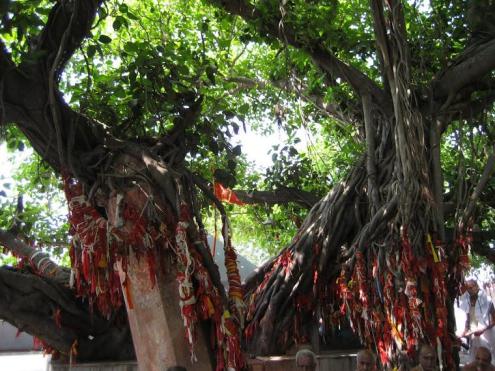
On the banks of the river Palguni at Gaya (Bihar State, India) there is a huge banyan tree (See the picture at the top). Special services are performed under this tree in remembrance of the elders who have passed away. This is called the “Gaya Shrardham”.
It is not uncommon among the traditional Hindu families where the elders would refuse certain food items in response to a vow they have taken as part of this Gaya Shrardham. While the tradition continues the symbolism is often not well understood.
Imagine a memorial service that starts with all the attention on a specific elder (FAM). The service ends with the remembrance that the departed soul and all other souls (in those who are alive as well as those departed) are one and the same. Hence the need is to reflect on the universality of the one soul and not its division as individuals (OMM). Finally the service is dedicated not only for this one person or his family of elders but the mind is permitted to enlarge remembrances and well wishes for all those that have deceased including children, disabled, animals and any form of living object that might have deceased. In this process whenever the mind hits a road block – negative response – it is re-directed towards inclusion and not exclusion (loving-kindness meditation).
Gaya Shradham may be intended to encourage practice of the LKM any time and at all times. As a remembrance of the LKM individual’s take an oath to forego some food item of their liking. Every time they come across that food item they would be implicitly reminded of the LKM state of mind?


 Spirituality In Practice
Leave a reply to asha Keshavan Cancel reply