
The essay: “Interactive Nature of Karma (Action), Bakthi (Faith) and Jnana (Wisdom and Reasoning) as Yoga pathways” has been published in the Jan. 2026 issue of veDa vaaNee, a E-Magazine: vEda vaaNee – E Magazine: https://vedasamskrutisamiti.org.in/current-issue-vol-3-issue-4-jan-26/
The entire paper is also presented below for our readers. A model based approach for Yoga as means for building Spiritual Resilience and Cognitive Resilience is elaborated in this paper.
Interactive Nature of Karma (Action), Bhakthi (Faith) and Jñana (Wisdom/reasoning) as Yoga Pathways.
Krishnamoorthy (Subbu) Subramanian
Innovation and Management Professional,
Honorary Editor, vEda vaaNee e-Journal
subbukdg@gmail.com
Abstract:
Traditionally Yoga is treated as three parallel and interconnected pathways. This leads to isolated emphasis on Karma (action), Bhakthi (faith) and Jñana (reasoning). The common element across all pathways of Yoga is Self-control through “Objectivity” and “non-attachment”. Emphasis on such self-control may be through implicit faith in our inseparable union with nature (Tat Thwam Asi), which may be identified and experienced as “Spiritual Resilience”. Self-control may also be influenced and managed through our management of the Guna (Connectors) to anything external to the “self” through our Knowledge, Bias and Ignorance. Such Cognitive Behavior Management of the self may be recognized and managed as “Cognitive Resilience”. Both Spiritual and Cognitive Resilience co-exist like two sides of a coin. They may also be envisioned as part of a feedback process in managing our body/brain/mind complex!
Introduction:
Karma Yoga, Bhakthi Yoga and Jñana Yoga are generally considered as three different pathways leading to the same common goal (i.e.) Self-realization(1). They are treated like three rivers merging into the same ocean. Our physical actions, emotional responses and intellectual reasoning are all interconnected within each of us. They are intertwined and inseparable. One cannot act without faith and reasoning, however limited or flawed they might be. Any thought is realized only through our emotions and actions. In that case, could these three pathways for self-realization be one and the same, only recognized differently like the reflections of the water, depending on the object reflected? Is it ever possible to pursue one pathway at the exclusion of the other? Are there benefits to such integrated view of all three Yoga, instead of them being understood or practiced as different, like silos? We address these questions in this paper.
Karma Yoga is the right action, for the right reasons and with proper emotional mindset.
Our heart, lungs, kidneys, blood circulation, digestion, brain functions, our vision, hearing, all other life processes work on their own, practicing Karma Yoga, all the time while we are alive! Even our mind practices Karma Yoga most of the time. For the thousands of miles you have driven in your lifetime, how many cars, roads, road signs or potholes do you remember? Every moment of your driving (over hundreds of hours) your body/brain, mind and intellect were and are actively engaged objectively, un-attached, practicing Karma Yoga! Every day, everyone does their life activities including caring for children, doing the work at the office, doctor caring for the patient, teacher teaching their students, player in the playing field, …. all happen unattached and with objectivity (without regard to personal immediate needs) (i.e.) Karma Yoga! Often quoted phrase for Karma Yoga, referenced from Baghawath Geetha (B.G.) Verse 2. 47 may be rephrased as:
All that exists are the activities you are responsible for (i.e.) your duties.
The results do not exist, since they will come only after your actions are carried out!
In other words, as a scientist, conduct your experiments; the results will follow whatever they are! Above is a way of looking at the verse differently from saying “You do not have the right to the fruits of action”! Above quote from B.G. merely states that the “results will follow” and you will partake that as appropriate with the right emotions and proper wisdom appropriate for that moment!
Another example to describe the above B.G. reference:
You get into the playing field to play. Scoring goals – the outcome – is incidental. There is no goal to be scored without playing! So, why be obsessed with goals (outcome)? Instead, be focused on the play and your move at every moment. Go ahead and play as best as you can and see what happens. Some of those moments during the play may end up as scoring goals by you or your teammates (or from the other team!). We are told that best players – identified as “Clutch players” – always play with the above mindset!(2)
Bhakthi Yoga is Faith / Trust/ Surrender to a larger cause (towards God in most religious pathways). It is also an emotional resilience that comes from an unshakeable faith in the thought “I am part of, and integral with nature: Tat Thwam Asi” (3). Faith may not be limited to God and His mercy alone. We practice faith in many ways, even in secular societies. For example, faith in the “Constitution” that everyone swears allegiance to is the bed rock of any Democracy.
Let us take a common example from our daily life: Driving a car appears to be merely an activity (Karma). Yet, even before one starts driving, one needs to have faith in the proper working of the car, trust that the car is safe and well designed and surrender to the notion that everyone will follow the rules and law (which after all are abstract in nature subject to interpretation) — (i.e.) We practice Bhakthi Yoga as a foundation for our action (i.e.) proper driving!
Bhakthi Yoga is our primary tool to manage our emotions and feelings. Bhakthi Yoga reflects as a balanced outlook, being Tranquil as needed (Satvikam), while being aware and keeping in check our emotional bias (Rajasam) and the delusion (Tamasam) that comes from our ignorance. It is important to acknowledge that we are always possessed or connected through these three ropes or connectors (Guna). It is a foolish errand to believe and pursue tranquil behavior all the time and live with a mindset that “I am not the one with bias and ignorance”! One who is more tranquil and “good natured” is required to reflect on the prevailing balance across these three Guna. In those moments of true self-reflection – soul searching – our Bhakthi (faith) in something larger than us – the Lord – serves as a goal post, as a reference to calibrate against. This intrinsic reflection and self-realization is Bhakthi Yoga? At moments of turmoil due to our bias driven by our intense desires, needs and wants or due to our ignorance predominating as obstacle to any progress or way forward, our faith (Bhakthi) lifts us up and restores our emotional stability. With such regained stability, our mind seeks new knowledge and a tranquil journey that follows. Such anchoring of the mind and restoring of our stability in emotions and thoughts are needed more often than we account for. Such moments of internal course correction are also less visible to others. Such stability and self-correction is needed for everyone – believers as well as non-believers in God. These are the moments we find Bhakthi Yoga at its most impact for everyone in our daily life? As an example, every man-made system, such as Democracy, rule of law and a civil society rely entirely on “faith” – Bhakthi – in a larger order and stable society! Our actions (Karma) could not come to fruition without Bhakthi (faith)!
Jñana Yoga is reflection and reasoning on the meaning and purpose of our thoughts. They are intimately connected to our Knowledge, Bias and Ignorance as much as are our actions and our emotions. As an example: Reading any book and understanding its contents is part of Jñana Yoga.
Jñana Yoga may be the most valuable tool and the necessary and missing link in our learning and understanding of Vedic Scriptures and the underlying Vedic Philosophy. One may chant prayers, visit temples, conduct prayer services – all reflecting Karma Yoga and Bhakthi Yoga. It is equally important to reflect and internalize the meaning and purpose behind those activities. Such understanding and internalizing of the principles is Jñana Yoga.
Interconnected nature of all three Yoga pathways:
I read a book – Karma Yoga
I have faith in its usefulness – Bhakthi Yoga
I learn and understand – Jñana Yoga
Thus Karma, Bhakthi and Jñana as Yoga (right action, with faith and reasoning) are always co-existing and inter-related.
A brief Google AI search, with the following questions and their answers(4) are posted below:
What is the most frequently mentioned in Upanishad among: Karma yoga, Bhakti Yoga or Jñana Yoga?
Jñana Yoga (the path of knowledge) is the most frequently mentioned and emphasized among the three paths in the Upanishads.
Karma Yoga is discussed in the Upanishads, often as a connecting link between desire and rebirth (samsara). However, the detailed system of Karma Yoga (selfless action without attachment to results, as a spiritual path) is more systematically developed and extensively discussed later in the Bhagavad Gita.
Bhakti Yoga: While the concept of devotion (Upasana, a precursor to Bhakti) is present in some later Upanishads, the full-fledged Bhakti Yoga (path of loving devotion to a personal God) is also more a prominent feature of post-Upanishadic texts like the Puranas and the Bhagavad Gita.
What is the most frequently mentioned in Bhagavath Gita among: Karma yoga, Bhakti Yoga or Jñana Yoga?
While all three yoga are discussed, Karma Yoga is the most frequently mentioned in Bhagawath Geetha.
What is the most frequently mentioned in Google AI database among Karma yoga, Bhakti Yoga or Jñana Yoga?
While a specific frequency count within the entire “Google AI database” is not publicly available, analysis of general literature and modern trends suggests that Bhakti Yoga and Karma Yoga are the most frequently mentioned or practiced paths than the more rigorous Jñana Yoga.
Karma yoga, Bhakti Yoga and Jñana Yoga – are they independent paths or interdependent?
Karma, Bhakti, and Jñana yoga are best understood as interdependent paths that are interwoven, not exclusive, although one might be a primary focus. They are different approaches to spiritual growth that can, and often should, be integrated, to achieve self-realization.
Admittedly the above is very limited, and insufficient scientific study. Yet two points seem to emerge consistently.
- Karma, Bhakthi and Jñana Yoga are seen as three independent paths serving the same goal. Integrated practice across the three is seen as desirable but not seen as a pre-requisite or inevitable.
- Karma Yoga and Bhakthi Yoga are seen as preferred paths for modern day practitioners, while Jñana Yoga might have been the center of focus during the period of writing of the Upanishad!
Karma (as Physical Action) is visible and evident to the self as well as for anyone (others). Hence Karma Yogi can be easily identified by his actions. This physical and tangible aspect of Yoga is also now well established as Hatha Yoga for physical fitness throughout the world(5).
With the above in mind, we can raise the following questions and seek answers:
If Karma Yoga is to be practiced in integration with Bhakthi and Jñana Yoga, then why such focus primarily on Karma Yoga, in modern day practice, as noted in the literature?
This could be for two reasons:
Bhakthi and Jñana are intrinsic – within one’s own emotions and thoughts. They are less visible. Managing our emotions (Bhakthi) and analytical reasoning (Jñana) are required for Objectivity and non-attachment, in our actions. Otherwise, engagement in actions with an emotionally balanced mind and with reasoning and logic (wisdom: Jñana) is not possible. A living tree produces fruits and flowers for others to enjoy (Karma Yoga). But “living tree” implies processes of nature which the tree – the self – experiences and practices. Such a “living tree” within us is governed by faith and wisdom, prerequisites for the outcome (i.e.) Karma Yoga in action.
Because of their intrinsic nature Bhakthi and Jñana require self-engagement or internalizing! They are difficult to describe or prescribe without their visible effects through action (Karma).
Consider for example two persons in the family – husband and wife, parent and child, siblings, etc. In each of the pairs, both will engage in the matters of the family. One may be a thinker and source of emotional stability through Jñana and Bhakthi. Their impact may be more through reflection, reasoning, guidance, counselling, motivation, …. in addition to their physical or material actions. Other may benefit from all this as part of a team and engage in actions – visible to all and with impact and benefit to all – (i.e.) Karma Yoga – yet governed by their own faith and wisdom (i.e.) Bhakthi Yoga and Jñana Yoga.
In terms of composition, we could say:
| Activities Identifiable as | Karma Yoga | Bhakthi Yoga | Jñana Yoga |
| Person 1 | 10% | 30% | 60% |
| Person 2 | 90% | 6% | 4% |
The actions of Person 2 as Karma Yogi may be more readily identifiable, relatable and teachable to others, compared to the actions of Person 1?
In Mundaka Upanishad (verse 3.1.1) (6) it is stated that
“Two birds, ever united and close companions, cling to the same tree.
Among the two, one tastes bitter and sweet fruits. The other looks on without eating.”
Traditional explanation for these two birds is the Prakruthi or the dynamic field of activities and Purusha / Soul / Consciousness – the enabler and the witness of the dynamic world and all that happens. These two birds remain inseparable, always together!
Perhaps we could consider the two birds as a pair, one engaged in Karma Yoga with Bhakthi and Jñana Yoga as the substratum and the other bird residing more in Jñana and limited in visible activities of Bhakthi or Karma Yoga. Such division and distribution of efforts may be based on the context, situation and circumstances in life. As an example, consider the case of Arjuna, from the epic – Mahabharata:
Arjuna is often described as an example of Karma Yogi (thanks to his righteous actions throughout his life, even though during periods of his life – (e.g.): during the B.G. Conversation – he was more like Person 1, intense in his faith and analysis and reasoning to find the right course of action (Dharma)! Then implement the right course of action deemed appropriate and necessary for the moment. This behavior could be seen more as Person 2 in our example above.
The inference by Google AI as noted above (i.e.) Karma Yoga is the most frequently mentioned in Bhagawath Geetha, and by inference it is preferentially emphasized, might be more of a perception conveyed by various writers in the database than an accurate reflection of the conclusion derived from B.G.
Controlling the sense organs (Indriyani) is good. Having control over the mind (Manaha) is better. Controlling the intellect (Buddhi) may be the best. The enlightened person controls all three and yet actively engages them without being affected by them. Such a person is considered to be the most superior of all. B.G. 3. 42
Above verse from B.G. suggests an integrated approach of Karma Yoga, Bhakthi Yoga and Jñana Yoga to deploy our body, mind and intellect in sync with each other.
Having become aware of the true nature of the enlightened person, who uses total self-control as a means to manage oneself, engage yourself vigorously in all your efforts. B.G. 3. 43
From the above we see “Self-control” is at the core of any Yoga. Self-control of our organs (Indriyani) and hence our actions is Karma Yoga. Self-control of our mind and hence our emotions is Bhakthi Yoga. Self-control of our intellect and hence our thoughts and analytical reasoning is Jñana Yoga. One can then infer that irrespective of the instrument controlled – Body, Mind or intellect – the fundamental requirement is the “process” (Yoga) I.e. self-control.
While the verse above states “enlightened person, uses total self-control as a means to manage oneself”, what is thatprocess?
Self-control (Yoga) is a balancing act between “Subjectivity” Vs. “Objectivity” and “Attachment” Vs. “Non-attachment”. This balancing act may be seen as a two-step process:
Self-control may be thought of as a balancing act between being implicitly in union with nature (Brahman) against all forces that influence one towards being an individual, distinct and separate from nature!Consider for example the wind blowing by. It spreads the odor or fragrance on its path. The wind is merely focused on moving whatever is in its path. The wind is Objective and non-attached to anything on its path! Upanishad states “that which enables the wind to move” is Brahman! (source: Kenopanishad).(7)
As humans, we are part of nature. Our hearts beat, lungs breathe, brain works, we digest food, we all have our parents (source like the seed for the tree), we have children and family (like trees and forest), etc. When we behave, feel or think like nature – objectivity and non-attachment is second nature to us. We remain as “Good Samaritans” without thinking (8).
Yet, by our human instinct we are drawn into our shell of “individuality”. Through this shell we acquire our identity such as our name, size, weight, family, needs and wants. They lead to our preferences such as good/bad. Like/dislike, …. These lead to our subjectivity (I, we, others, different from each other, different from nature) and attachment (mine, ours, ….). This balancing act of being in union with nature vs. being individual human is one of self-control, the core principle of Yoga. It is illustrated as the balancing act across two sides of a coin in Figure 1.
We can also use the analogy of the deep ocean and the waves on its surface. The deep ocean represents the contemplative state of Yogi (in true union with nature). The ever-present waves represent the constant perturbation we face in life called Vasana (Experiences). Through Self-control (Yoga) we manage the ever-present ebb and flow of life. This requires objective and un-attached assessment of our Guna (Connectors) evidenced as Tranquility, Turbulence and Inertial states. They are enabled by the prevailing Knowledge, Bias and Ignorance. While these three connectors co-exist, dominance of one over the other two, determines our “experience”. This is the second balancing act, also noted in Figure 1.
Hence, through Yoga, or self-control, we have two modes of balancing act: One to manage our cognitive behavior to remain at a minimum of perturbation. The other to constantly recenter our actions, emotions and thoughts such that we strive to remain in harmony with our natural state (i.e.) as implicit and integral part of nature (Tat Thwam Asi). These may be identified as Cognitive resilience and Spiritual resilience, respectively. The details of these two steps or balancing acts are schematically illustrated in Figure 1.

Figure 1: Yoga as a balance act, developing Spiritual and Cognitive resilience
Returning to the two birds (analogy cited earlier from Mundaka Upanishad), we could reflect on the bird eating and chirping away as the human practicing “Cognitive resilience” through the various Yoga pathways and the other bird, the calm, quiet witness as the same human being practicing “Spiritual resilience” as illustrated in Figure 1.
As human we are a system composed of our “mind/brain/ body” complex – Figure 2. All our actions, our participation or engagement in life occur through this complex system. Of these, the brain and body as physical organs are well understood. Mind as the center, the controller and manager of our actions, emotions, feelings and thoughts and its interactive role with our brain and body is the subject of intense studies by experts around the world. This subject is dealt with in detail under the field of Neuro Psychology (9)

Figure 2: Human as a “Mind/ Brain/ Body” system
We could rely on Vedic Philosophy to provide a systematic and interactive approach to the functioning of our body/Brain/ mind complex. The pathways for Cognitive resilience and their practice lead to the channels of Yoga as illustrated in Figure 3,
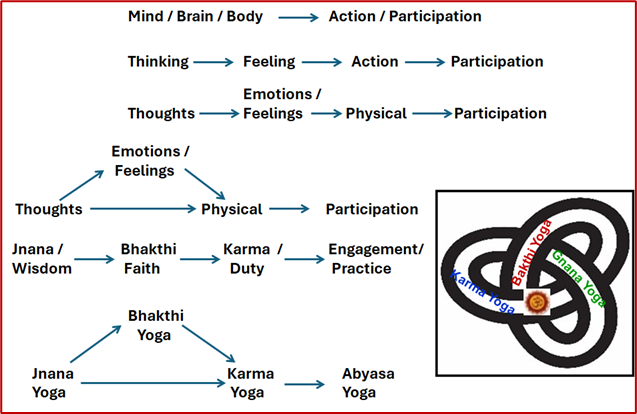
Figure 3: Cognitive Behavior as an interactive management through the three Yoga pathways(10)
By their very nature each Yoga pathway, when practiced to perfection, will lead to interaction with the other two. This is also emphasized in B.G. verse 8.8.
अभ्यासयोगयुक्तेन चेतसा नान्यगामिना |
परमं पुरुषं दिव्यं याति पार्थानुचिन्तयन् ||8||— B.G. 8.8.
abhyāsa-yoga-yuktena chetasā nānya-gāminā
paramaṁ puruṣhaṁ divyaṁ yāti pārthānuchintayan
With relentless practice (Abhyasa Yoga), when you constantly engage the mind in Me (towards Total Self-Control, Objectivity and Non-attachment), you shall attain me (the Lord, Brahman, Universal Consciousness, bliss as the state of mind of bliss)(11)
Every Input / Process (Transformation)/ Output system could be managed through feedback of the outputs to control the inputs. It is the basis of classical control theory. (12)
Having recognized the Mind/Brain/Body as a “transformer” we can envision “Yoga” as a feedback controller with its two components: Spiritual resilience and Cognitive resilience. These details are illustrated in Figure 4.

Figure 4: Yoga Pathways visualized as part of a control system for our “Mind/Brain/Body” complex.
Conclusion:
Karma Yoga, Bhakthi Yoga and Jñana Yoga are the three most common and well-known pathways for self-control. These pathways for self-control are inter-related. They require constant reflection and balance between subjectivity vs. objectivity and attachment vs. non-attachment in our action, faith and reasoning, respectively. This feedback control may be thought of as “Cognitive Resilience”. Being objective and unattached is the way nature always exists. It is how the driving force – the spirit – of everything we know of or relate to, exist. Practice of Yoga through any of the three pathways, to identify ourselves as integral and inseparable part of nature (Tat Thwam Asi) may be identified as “Spiritual Resilience”.
References
- https://blog.bhaktimarga.org/4-types-of-yoga-in-the-gita (Accessed on Dec. 16, 2025)
- Being a clutch player in life: https://pca-nwa.com/being-a-clutch-player-in-life/
- “Tat Thwam Asi” – Maha Vakya (Grand pronouncement) from Chandogya Upanishad.
- Google AI search on Nov. 25, 2025 with prompts as questions mentioned in this article.
- Yoga as a common name for exercise for Physical fitness. https://www.mimamsayogshala.com/blog/hatha-yoga-definition-history-benefits/
- Mundaka Upanishad Verse 3.1.1.
- Kenopanishad Reference – Brahman that enables the wind to move: https://www.anaadi.org/post/who-moves-everything-insights-from-the-kena-upanishad
- https://vedasamskrutisamiti.org.in/wp-content/uploads/2025/10/R3.-Axioms-of-Vedic-Philosophy-%E2%80%93-Tools-for-Being-and-Becoming-a-Good-Samaritan_41-46.pdf
- The Behavioral and Social Sciences: Achievements and Opportunities. https://www.ncbi.nlm.nih.gov/books/NBK546486/
- Enlightened living: KY, BY and JY as seamless interconnected pathways. Figure 4.6., Page 101, Spirituality in Practice, Krishnamoorthy (Subbu) Subramanian https://www.amazon.com/Spirituality-Practice-Exploration-collaboration-cohesiveness/dp/B0BV49NPNQ
- Abhyasa Yoga – Bhagawath Geetha Chapter 8, Verse 8.
- What is a feedback control system: https://automationforum.co/what-is-a-feedback-control-system-and-what-are-its-types
 Spirituality In Practice
Leave a comment