
Vedanta or Vedic Philosophy defines the Universe, nature or ALL of existence as Brahman. Such Brahman is described as Sat Chit Anandam (i.e.) Universal Reality, Awareness of the same and the Infinite joy as a result!
Oneness: Consciousness Explained | Swami Sarvapriyananda https://www.youtube.com/watch?v=0Zrr8v1VqIU
Brahman as the “enabler”, we (Human) and everything we know of (Universe) as the “enabled” exist as two sides of a coin – Co-existing and inseparable. It is also like the deep ocean and the constantly churning waves on its surface. Ocean waves and the deep ocean are one and the same! The gold ornament, the enabled, is very much gold, the enabler. The Brahman is both the enabler and the enabled! The substratum as well as the evidence at the surface level! Everyone and everything is both enabler and enabled!
Spiritual resilience may be defined as a mind and a way of life that is in implicit and unconditional union with Brahman, the enabler – nature – as a whole! It is the true belief, acceptance and living by the Maha Vakya (Grand Pronouncements) from Upanishad:
- This Self is Brahman – Ayam Atma Brahma (Atharva Veda – Mandukya Upanishad)
- You are Brahman : Tat Twam Asi (Sama Veda – Chandogya Upanishad)
- I am Brahman: Aham BrahmaAsmi (Yajur Veda – Brihadaranyaka Upanishad)
- Consciousness is Brahman: Pragjnanam Brahma (Rig Veda – Aitareya Upanishad)
This thought of undivided existence brings with it, a profound peace and harmony within and with all that surrounds us. It is the result of “Spiritual Resilience”!
Saints like Ramakrishna Paramahamsa and Ramana Maharishi might have lived in this state of bliss (in union with Universal Consciousness) uniquely for extended periods of time. For instance, here is a brief excerpt from the life of Swami Ramana Maharishi:
It is well-documented in the biographies of Ramana Maharshi that he spent time in a snake-infested underground vault, and he also had numerous, close encounters with snakes while living on the holy hill of Arunachala.
The Patala Lingam (The Snake Pit): Shortly after arriving in Tiruvannamalai, a holy mountain-temple in South India, the young Ramana (then known as Brahmana Swami) withdrew to an underground, windowless, and dark vault beneath the thousand-pillared hall in the main temple, known as the Patala Lingam. The term Patala can mean “snake’s cave” or “underworld”. He sat there in deep, motionless samadhi, and the vault was, according to accounts, overrun with ants, wasps, and other pests, with his legs becoming covered in ulcers from the conditions.
Close Encounters at Skandashramam: Later, while living on the hill at Skandashramam, Ramana Maharshi had friendly, almost intimate relationships with snakes that frequented the area. One particular black cobra used to visit him, and it was documented that a snake once crawled over his legs, which he described as feeling like a “tickle”.
Attitude toward Snakes: Ramana showed absolutely no fear of snakes, viewing them as part of the nature of Arunachala and often instructing others not to harm them. He once famously stopped a peacock from fighting a large black cobra that approached him, by calmly telling the snake to leave.
It is not that he was “found” trapped or endangered by a snake in a pit, but rather he chose to dwell in a damp, snake-infested, underground cell (the Patala Lingam) to continue his intense, undisturbed, and deep, silent meditation.
Google search: Ramana Maharishi was found in his meditation in a snake pit
Spiritual Resilience is a gift of nature to everything. Only for human beings, enabled by our mind, it is a cultivated habit!
As the “enabled” – the other side of the coin or as part of the waves on the surface, we are ALL different from each other! Like the ocean waves, these differences never subside. But, you can understand their characteristics through the prevailing connectors (Guna) and their underlying Knowledge, Bias and Ignorance. Their content and proportion change moment to moment, based on time, situation and circumstances. Their nature becomes clear and better focussed thanks to our Objectivity (equal regard for all evidence and the underlying K, B and I) – Sagunathvam – and non-attachment (without preference to their sources or self-centered needs and wants)- Sanyasam; Yagna Spirit. It is engaging our mind, the way nature exists! This is Yoga (Union with the self), practiced through our thoughts (Jnana Yoga), through faith / trust and surrender (Bhakthi Yoga) and witnessed in action (Karma Yoga).
One can never be absolutely objective or totally un-attached. One in that ideal state, we regard as God (Yoga Eshwara). Managing the three Guna, through K, B and I as the reins with the best objectivity and non-attachment is Cognitive Behavior Management. It fosters “Cognitive Resilience“.
Spiritual Resilience and Cognitive Resilience are described and illustrated in the video: Vedic Philosophy – Practical Aspects in Daily Life (59.00 – 1.05 Min.): https://www.youtube.com/watch?v=V08igVlN4RA
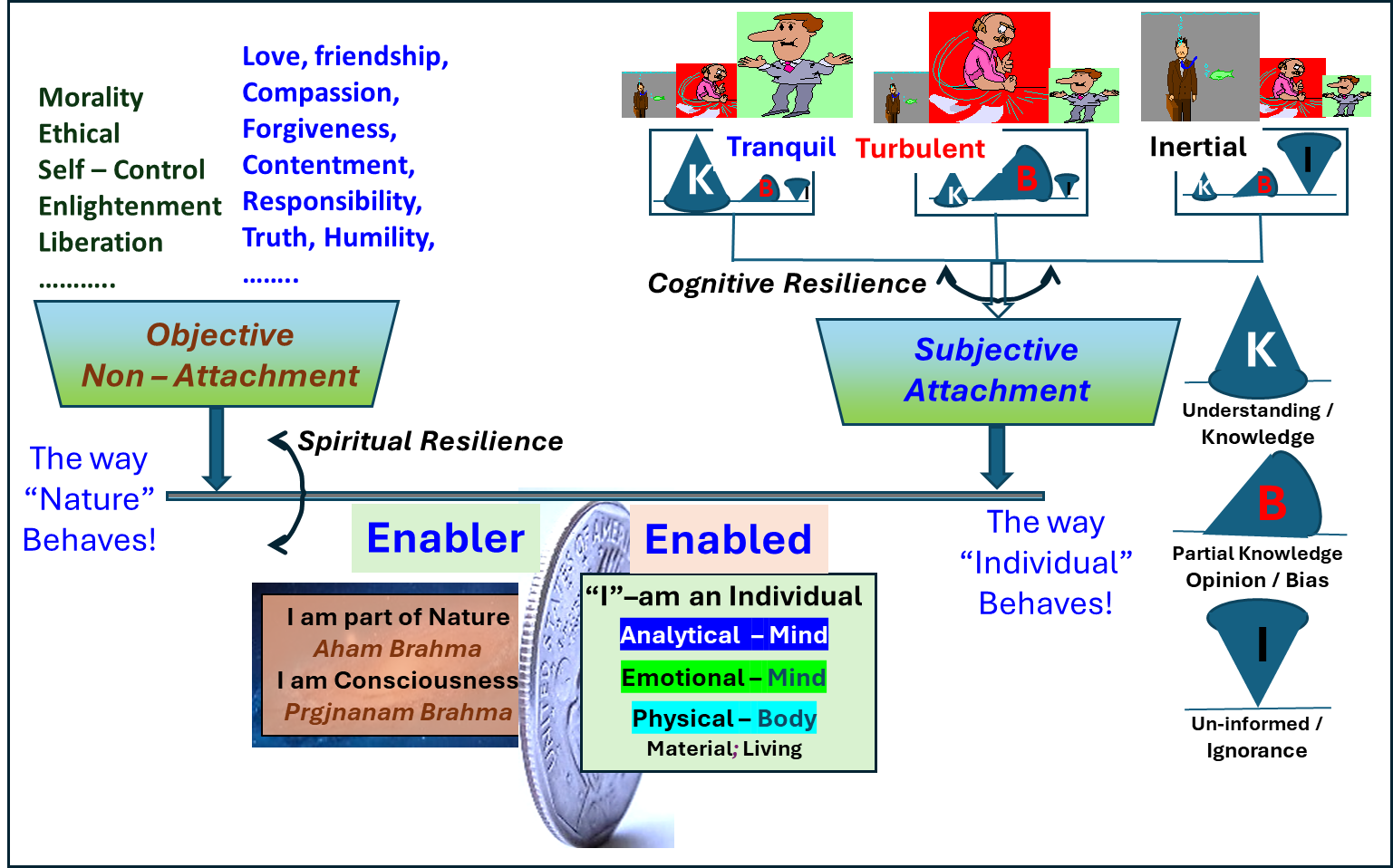
Managing the connection between the “enabler” and “enabled” – Cognitive Behavior Management (Management of the Guna through self-control, Objectivity and non-attachment) – is among the core of the teachings from Bagawath Geetha. It is tabulated as noted below:
| Consciousness | Guna (Connectors, Rope) – Tranquility (Satvikam), Turbulence (Rajasam), Inertial (Tamasam) Thanks to the prevailing Knowledge, Bias and Ignorance . | Cognitive Person |
| Soul / Athma | Body | |
| Dehinam | Deham | |
| Purusha | Prakruthi | |
| Brahman | Bootha SangaH | |
| Driver / Enabler | Driven / Enabled |
Traditionally Yoga as a physical activity, meditation to calm and control the mind and our thoughts, rituals, religious practices and austerity such as worship, fasting, etc. are used as a stepping stone towards acquiring Cognitive as well as Spiritual resilience.
Frequently we are unable to see the reality (i.e.): life as the “enabler” – through Spiritual Resilience – and “enabled” – ability to manage life through Cognitive Resilience. It is like trying to save the burning object, without acknowledging the fire and how to extinguish that. It is like believing the reflection or image in the mirror as th real object! This is described as the biggest illusion (Maya) according to Vedic Philosophy. Swami Vivekananda has noted that “One who runs away from daily life (samsara), and spends time in the caves of the Himalayas to meditate and die, has missed the way”.
Benefits through “Spiritual” and “Cognitive” resilience:
Balanced living through both Spiritual as well as Cognitive Resilience – described as “Enlightened living” – has many direct and practical benefits in our daily life!
Spiritual Resilience provides calmness and stability for our mind, thoughts, emotions and actions. It is like a large vessel anchored properly and hence remains stable irrespective of the prevailing wind and other ambient conditions. Spiritual Resilience provides clarity and direction for a range of abstract human centered concepts such as Morality, Ethics, Love, Friendship, Forgiveness, Contentment, Truth, ….
Absence of Cognitive Resilience is the source of all our perturbations, which we call as daily life (Samsara). Such tumult is driven by our unrelenting needs and wants and an inability to satisfy them adequately! All education in any subject would appear to be an effort to enhance our ability to understand and manage the Knowledge, Bias and Ignorance pertinent to that subject. Every professional at his/her best excels in cognitive resilience in their field of expertise!
Most scientific discoveries – and even inventions – as well as excellence in leadership of any kind are the result of a combined outcome of Spiritual Resilience and Cognitive Resilience?
Swami Ramakrishna Parahamsa was clear on the distinction between the “Spiritual” Resilience Vs. daily activities to gain “Cognitive” Resilience as illustrated from the excerpt below:
Once Sri Ramakrishna stood on the semicircular veranda and called, “O maya, please come.” Gauri-ma was astonished and asked the Master why he was calling for maya. Then he explained that the natural tendency of his mind was to soar to a very high realm, and it was hard to bring it down. He was calling for maya so that his mind would stay in a lower plane, making it possible for him to help his disciples. This shows what love the Master had for them. He used to send them to different temples of Dakshineswar or to the Panchavati for meditation. Over each one he kept a watchful eye, and if he observed that a disciple was performing too much austerity or fasting, he would say: “Please eat your meals regularly and then practise your japa and meditation. The Divine Mother is not a stranger. She is your very own. She will not be angry if you eat first and then call on Her. In this Kaliyuga the human body cannot bear excessive austerities, and it is hard to practise spiritual disciplines if one’s health is not good.” At the Master’s behest, Gauri-ma sometimes cooked food for the disciples, whom she regarded as her own children.
They Lived with God, Life Stories of Some Devotees of Sri Ramakrishna, by Swami Chetanananda, Chapter 12 Gauri-Ma, p 183
Above reference is cited from the weekly newsletter from: www.vedantastl.org Jan. 30, 2026
 Spirituality In Practice
Leave a comment