
Happy Thanks Giving to All!
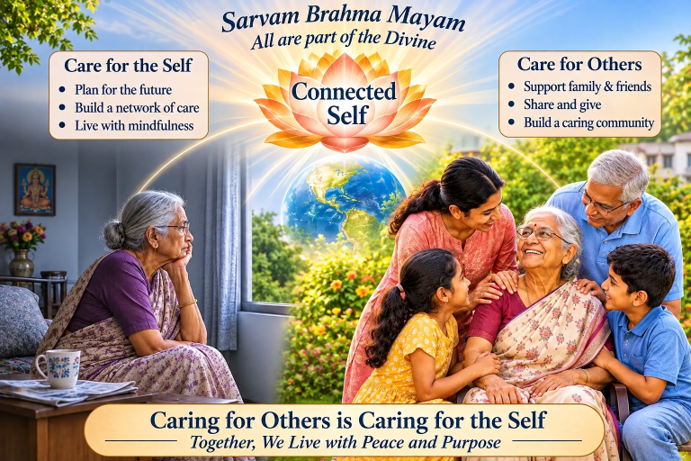
Recently, I came across a video link that had been forwarded to me: https://www.facebook.com/reel/1020658187757564
The video describes the urgent need to care for elderly people who live alone and are no longer able to look after themselves. It tells the story of an elderly woman in Mumbai who lived in an apartment in a high-rise building and had passed away without receiving the help she needed. Her neighbors reportedly placed an advertisement in search of her children, who may not have been in contact with their mother for a long time and whose whereabouts were apparently unknown.
When I first watched the video, I became emotional, as most people would. After some time, I watched it again with a clearer and calmer mind. Some of what it presented may be true, but some claims deserve to be questioned. For example, the narrator says that the woman had not been in contact with anyone for 40 years. He then adds, with dramatic effect, “nobody had visited her for 40 Diwalis!” How could he know so much from a single newspaper advertisement? The video also describes another mother who was left alone at an airport after being robbed of the money she had received from the sale of her home.
Stories like these certainly attract our attention. But messages of this kind, even when well-intended, can also generate anger and anxiety. If they are presented without sufficient evidence or context, they may encourage Bias and Ignorance rather than Knowledge and understanding.
Understanding the scale of the problem
The video also cites some statistics: 38% of single elders receive care from neighbors and other community members, while another 20% receive help from children who live far away. Together, they account for 58% of the population who need care from others. According to the video, around 16% receive no attention at all.
If these figures are accurate, the number of single elders living without any caregiver is not the majority. It is nevertheless a serious concern—one that may be manageable, if society as a whole recognizes it and responds. Perhaps that is the laudable purpose behind the video.
The real issue
The more important questions are these: How can a person who lives alone prepare for the later years of life? How can that person build a network of caregivers who can provide support when age or illness makes independent living difficult? I offer a few suggestions.
Begin with faith and conviction that everyone and everything is part of Nature (Sarvam Brahma Mayam). Let that conviction guide the way we live:
- Maintain a network of friends and relatives—nearby and far away, including neighbors and members of the wider community.
- Live a life of mutual care. Nobody becomes old or unable to care for themselves suddenly. When you are young and able, make time to care for others.
- Work out an understanding with the people in this network about how they might support you when you become old or unable to look after yourself. Being a Good Samaritan is a virtue; planning for one’s own long-term care is also an expression of objectivity and non-attachment.
Having done what is reasonable and within our control, we must also learn to leave the rest to Nature or Divine will. Your good deeds will protect you: Dharmo Rakshati RakshitaH
- Live without fear, for as long and as well as you can. Make your life one of caring for yourself as well as caring for everyone and everything: Sarve Bhavantu SukhinaH.
- When you are gone, the responsibility for handling your material body belongs to those who remain. It need not become a source of anxiety during your lifetime.
Learning from spiritual literature
The suggestions above are neither a wishful list nor an attempt to dismiss the emotional difficulty of the subject. They are grounded in a way of looking at life that becomes clearer when we read and reflect carefully on spiritual writings.
The prayer song Bhaja Govindam by Swami Adi Sankaracharya is a good place to begin. The following passages convey several relevant lessons:
“Oh foolish man, give up your relentless passion for material objects. Replace it with a passion to learn the truth about Reality. With that in mind, enjoy whatever you receive as the reward of your efforts in the material world.” (2)
“As long as you are seen as a productive member of the family, you are wanted and welcomed. When you become old and unable to contribute, no one wants to speak even a word with you.” (5)
“As long as a person is alive, there are relatives. When the breathing stops, even his/her wife/husband is afraid to be near the dead body.” (6)
“With the passage of youth, passion for sensual pleasures also disappears. When wealth has diminished, there are no longer many followers. There is no lake when all its water has evaporated.” (10)
These verses remind us to be mindful of our own needs and to care for others while we are healthy and able. This is the message behind the first three suggestions above. At the same time, our minds should be rooted in a deeper understanding of the permanence of Nature and the Divine reality that leads to oneness with all. It is this expansive outlook that inspires us to care for others while we are well and able.
A related message appears in the following verse:
“For one who has studied the Bhagavad Gita—and has internalized even a little of its inner concepts and guidance—who has sipped even a drop of the holy Ganges water, or who has worshipped the Lord even once, there is no quarrel with the Lord of Death (Yama) at the time of death.” (20)
Studying the Bhagavad Gita, making pilgrimages to holy places, drinking the holy water of the Ganges, and worshipping the Lord should not become blind rituals. Their meaning should be reflected in our actions: caring for elders while they are alive and respecting their memory after they have passed away. These are among the deeper messages behind the fourth and fifth suggestions above.
Turning reflection into action
Disturbing as the advertisement and video may be, they should serve as a wake-up call. At any age, each able-bodied person can pause and ask: How much of my life today is devoted to caring for others?
It is not always easy to find room in our hearts to help people in need—especially neighbors or relatives who may not have cared for us when they were young and able. We must look beyond such disappointments and respond to the needs of elderly people who require help. This responsibility extends even to those whose own choices or mistakes may have contributed to their present dependence. Their actions may call for accountability, but they should not be abandoned or pushed to the wayside. None of us is perfect; those who are free of mistakes are far fewer than those who are not. If we make perfection a condition for receiving care, very few of us would qualify. Recognizing another person’s shortcomings without denying that person’s dignity calls for objectivity, non-attachment, and compassion.
It is in moments like these that the call to action from Bhagavad Gita becomes real: “Do your duty, undeterred by your emotional mind and its needs, wants, or expectations.”
Vedic philosophy and literature offer rich resources for guiding and modulating our lives and, in turn, helping others. There is also an opportunity for NGOs to employ unemployed young people to visit and check on elders who live alone, including the 16% whom the video identifies as having no one to care for them. Caring for each other is also a responsibility of neighbors. People who live in modern high-rise apartment buildings are neighbors to one another just as much as people who live in small huts in villages and rural communities. Could supporting such neighborhood-based elder care become one of the corporate social responsibility (CSR) missions of companies in India?
Conclusion
This spirit of caring for others as an expression of caring for the Self – the soul – might be called “God’s work in human life.” Such care should not be conditional on whether a person has lived perfectly, made the right choices, or always treated others well. We are all imperfect, and none of us can know when we may need the understanding and support of others. Could temples, missions, and Swamijis help foster this spirit? Is this what we mean by “Spirituality in Practice”?
Acknowledgement:
Thanks to my friend for sharing the video link with a suggestion to look int it.
The image above is AI generated!


Leave a Reply